
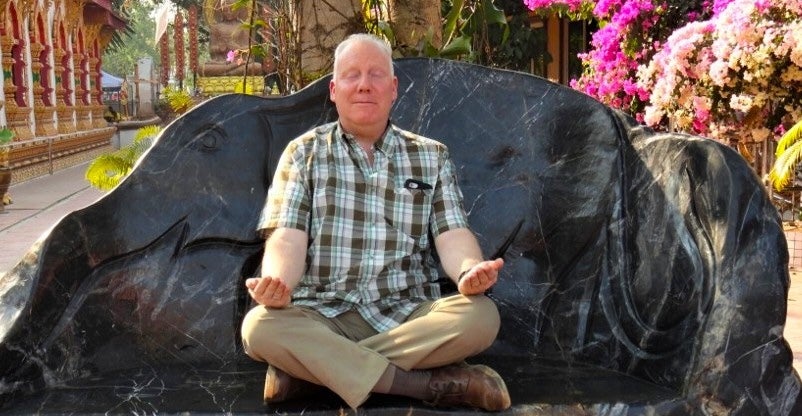
From Bowerbirds to Global Cancer Research: Christopher Loffredo Looks Back on a Four-Decade Career
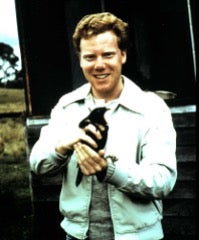
For his Master of Science in Zoology, Loffredo conducted field research at Wallaby Creek in Beaury State Forest, New South Wales, Australia.
In 1983, 22-year-old Christopher Loffredo stood in the Australian bush recording the songs male satin bowerbirds use to attract mates.
More than four decades later, standing before colleagues at Georgetown University, Loffredo reflected on a career that took him from zoology to hospitals in Egypt, villages in Thailand, nuclear facilities in Russia, and cancer prevention programs in Brazil and Eswatini.
The Cancer Prevention and Control Program at Lombardi Comprehensive Cancer Center hosted Loffredo’s valedictory lecture ahead of his transition to professor emeritus on July 1, 2026.
“I prepared a presentation to give you a sense of where I have been,” Loffredo began.
The answer, it turns out, is in many corners of the world.
A Change in Direction
Although Loffredo began his career studying evolution and animal behavior at the University of Maryland, his path shifted after he answered an ad in the newspaper.
“The ad was for help with statistical analysis and programming for an epidemiological study,” he said. “And guess what? I fell in love with that field.”
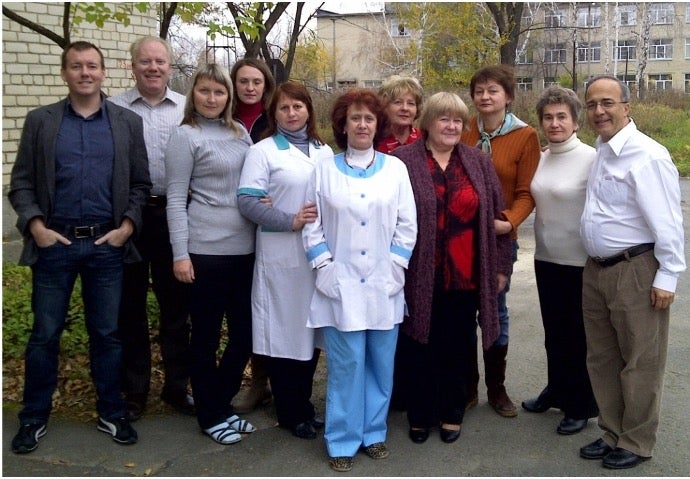
In Russia, Loffredo (second from left) found higher rates of bile duct cancer and hepatocellular carcinoma among Russian nuclear workers, as well as unusually high rates of liver angiosarcoma among women.
That experience shifted his focus toward cancer prevention and global health.
After 14 years at the University of Maryland, Loffredo joined Georgetown in 2000, where he focused on cancer epidemiology and prevention, often in settings with high disease burdens and limited research infrastructure.
Generating Population-Level Insight
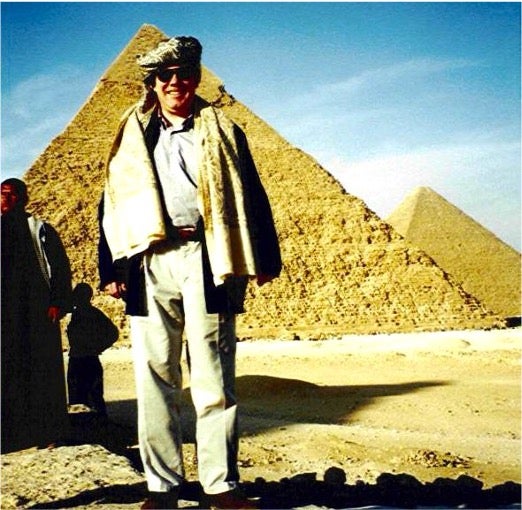
Loffredo stands before the Pyramids of Giza during one of more than 40 trips to Egypt.
One of his longest-running collaborations began in Egypt, where he spent more than two decades studying liver cancer. The work began while he was at the University of Maryland after a mentor encouraged him to study the disease. Loffredo continued the research after joining Georgetown, where the pilot study grew into a project that included about 1,000 people with liver cancer and a similar group without the disease.
The findings showed that hepatitis C accounted for roughly 95% of liver cancer cases in the study population, helping to clarify the causes of one of the highest liver cancer rates in the world.
Loffredo later expanded his work to include bladder cancer, tobacco use, substance use among youth, and cancer prevention interventions. He helped establish a nationwide tobacco survey in Egypt and led community-based efforts to reduce secondhand smoke exposure among women and children.
Bringing Research to Communities
A defining feature of Loffredo’s work has been his commitment to understanding health challenges by focusing on the communities where they occur.
That approach guided a study in Thailand examining cholangiocarcinoma, a rare bile duct cancer that occurs at rates nearly 100 times higher than those seen in the United States.
Rather than relying solely on data collected in Bangkok, Loffredo encouraged the research team to visit rural villages and speak directly with survivors. The approach also reflects a value central to Georgetown’s Catholic and Jesuit tradition: accompanying communities by listening first and allowing their experiences to shape the work.
“You have to get out to the areas and see where people live and how they live,” he said.
Those visits helped researchers better understand the role of environmental exposures such as pesticide use in the agricultural fields where survivors worked and dietary practices that shape cancer risk.
More recently, Loffredo launched a study examining liver cancer stigma in Thailand. Through surveys and interviews, he studied how patients experience blame, misunderstanding, and discrimination following a cancer diagnosis.
A Teacher First
While Loffredo’s research has spanned continents, he devoted equal energy to teaching and mentorship.
Over the course of his career, he developed seven courses, taught eight different classes, and mentored undergraduate students, 51 master’s degree students, 27 doctoral students, and three postdoctoral fellows. He also mentored four Fulbright Scholars and helped establish a clinical oncology observership at Georgetown University Medical Center.
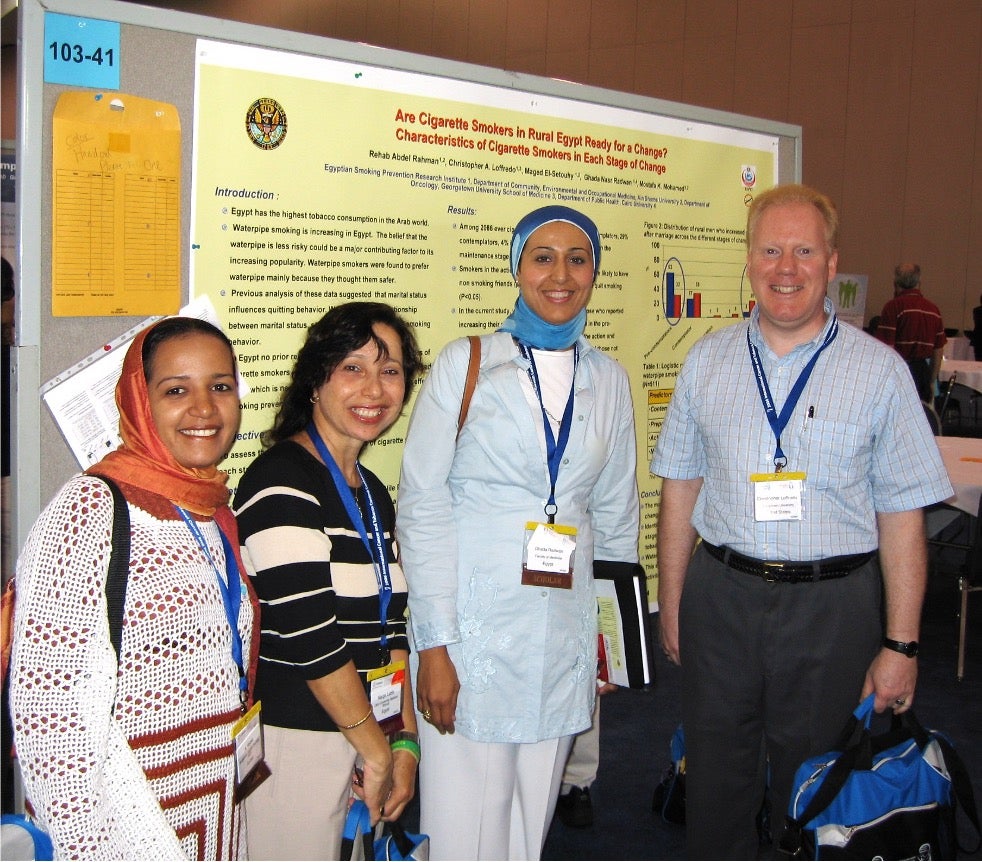
Faculty and pre-doctoral students from Cairo University during a tobacco smoking research conference in Cairo, Egypt.
“Students teach you just as much as you teach them,” he said.
In addition to formal mentorship, he created training opportunities for young scientists around the world, including short courses in scientific writing, grant writing, epidemiology, and research methods. He also directed a summer cancer education program that trained 19 students over five consecutive years.
Next Chapter

A geranium tended by Loffredo.
Becoming Professor Emeritus, however, is less an ending than the beginning of a new chapter.
Loffredo plans to continue writing, building on the recent publication of his book, Globetrotting for Science, which chronicles many of the international research experiences he shared during his lecture. He also hopes to expand his work as a Master Gardener, take art classes, and spend more time pursuing lifelong hobbies, including stamp collecting.
“I’m not going to sit around doing nothing,” he said.
For those who know him, that may have been the least surprising statement of the day.