
Global Health Student Fellows Advocate for Tuberculosis Funding on Capitol Hill
Global Health Student Fellows joined the annual MedStar-Georgetown Global Health Advocacy Day on Capitol Hill to call for stronger federal investment in tuberculosis programs, taking part in 54 meetings with more than 70 advocates that reached offices in different parties and states.
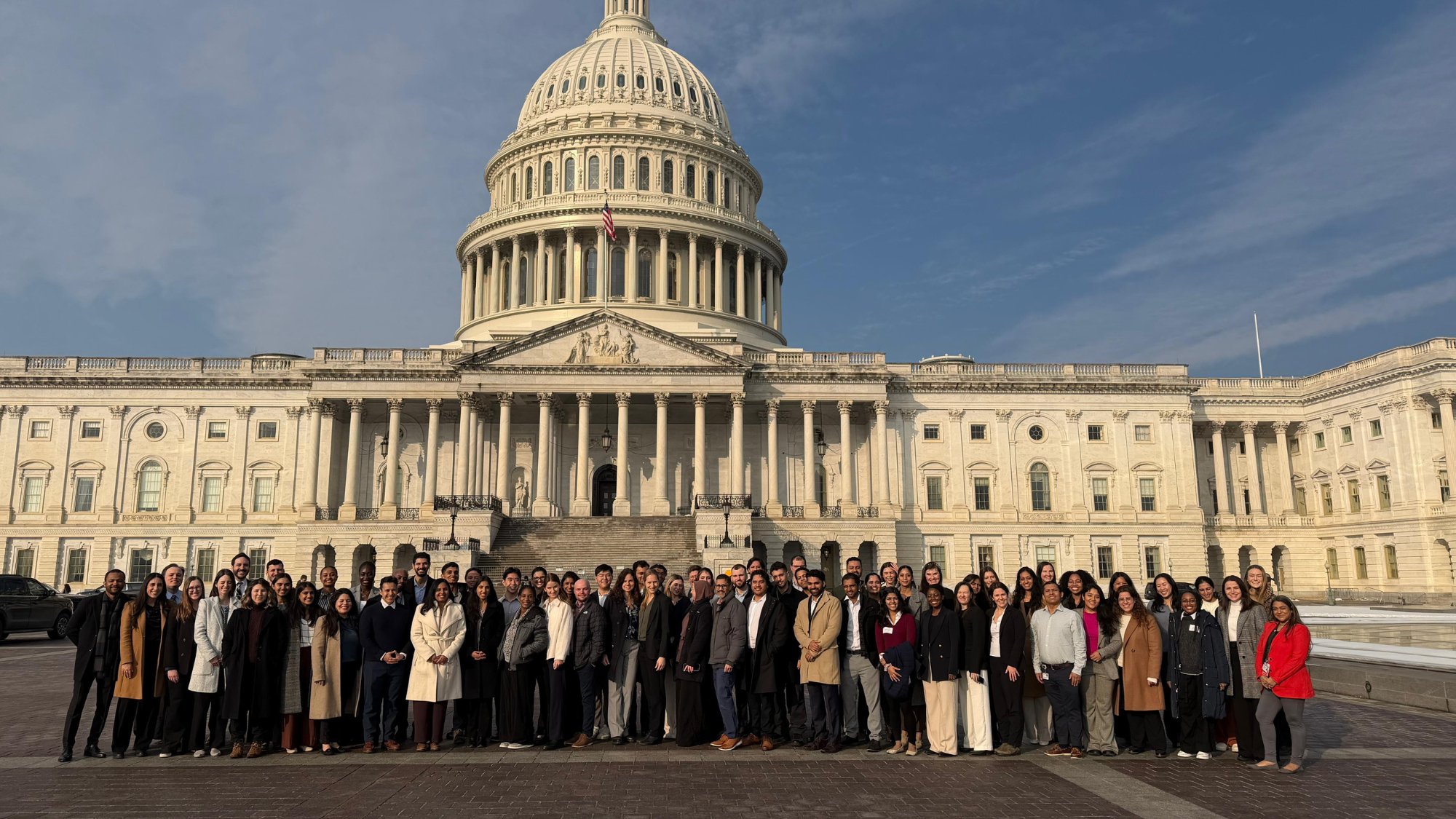
MedStar Health-Georgetown University residents in the Social Medicine & Health Equity Track and the Global Health Equity Track, along with the Global Health Student Fellows, spoke with congressional members about tuberculosis treatment and research.
Roma Jha (H’26) had previously sat in on congressional meetings as an intern.
This time, she was the one making the case.
Her visit, alongside MedStar Health-Georgetown University residents and faculty, came as the U.S. Congress began negotiating the next federal budget, a process that will determine how much the United States commits to tuberculosis programs at home and abroad.
Advocates say the stakes are high, as domestic tuberculosis cases have risen for the third consecutive year and global progress in reducing cases and deaths has slowed.
Advocacy in Action
Over the course of the day, students moved between the House of Representatives and Senate office buildings in small groups to meet with legislative staff responsible for health portfolios.
Jha, an undergraduate student studying health care management and policy, met with staffers for Senator Andy Kim (D-NJ), who once represented her home district.
“Hill Day reminded me that constituent advocacy and meetings can really make a difference, a nice realization at a moment where many things in health policy feel so distant from what constituents want,” Jha said.
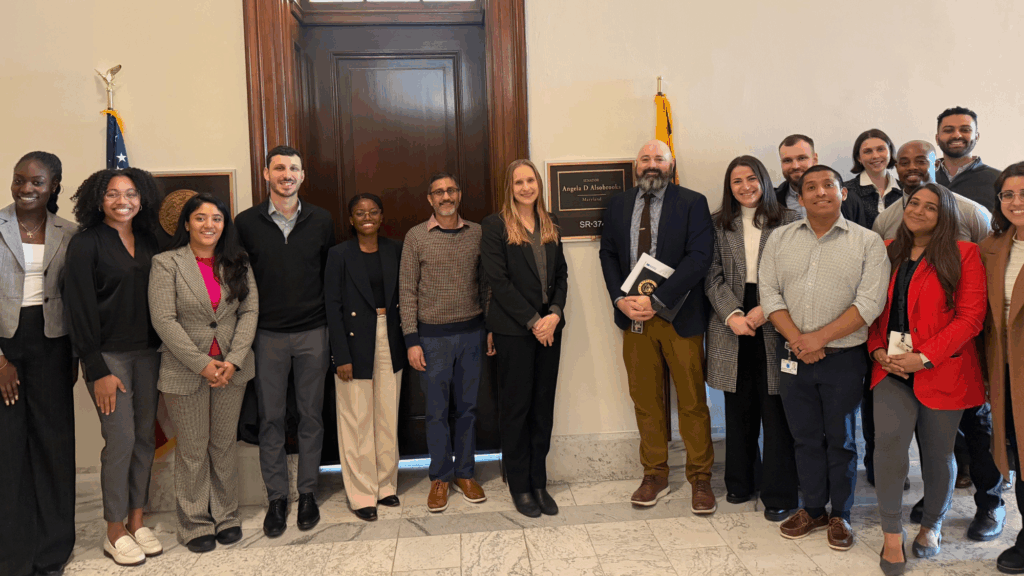
Kayla Wontumi (H’27), a Global Health Student Fellow and Maeve Kennedy McKean Award recipient, with residents and faculty outside Senator Angela Alsobrooks’ (D-MD) office.
For Alhassan Barrie (G’26), whose clinical experience treating patients in Africa informs his research interest in drug-resistant disease, the issue also hits close to home.
“Knowing that my home state of North Carolina alone has an estimated 200,000 latent tuberculosis cases made the issue feel both global and local,” said Barrie, a master’s degree student in global health.
When he met with staff in the offices of Senator Ted Budd (R-NC) and Representative Alma Adams (D-NC), he was struck by the chance to raise awareness of the burden in their state.
“Explaining the data and seeing their reaction shift toward concern and interest in action was powerful,” he said. “It showed how much impact clear, evidence-based advocacy can have.”
Training the Next Generation
For Rosie Poling (G’27), a policy officer at Partners in Health and one of the event’s organizers, the advocacy day reflects a growing pipeline of new voices.
New tools make it possible to end the disease, she said, but the gap between what programs need and available funding remains wide, particularly after tuberculosis services were disrupted in several countries following last spring’s program closures.
“The federal budget is a reflection of our values, and public funding only exists when people put in the effort to actively engage their policymakers. You can’t get what you don’t ask for,” Poling said.
She first came to Capitol Hill as an 18-year-old student advocate, an experience that shaped her career in global health policy. Now working full-time on the Partners in Health advocacy team, she sees the same sense of possibility in the students she helped convene.
“I hope they continue to advocate for the priorities that matter to them,” she said.
- Tagged
- Kathy Stolarz