
Georgetown Students Win Interprofessional Prize at 2025 DC Public Health Case Challenge
An interdisciplinary team from Georgetown University’s College of Arts & Sciences, School of Foreign Service, and School of Medicine won the Harrison C. Spencer Interprofessional Prize at the 2025 DC Public Health Case Challenge. The team participated through an initiative led by the Georgetown University Global Health Institute.
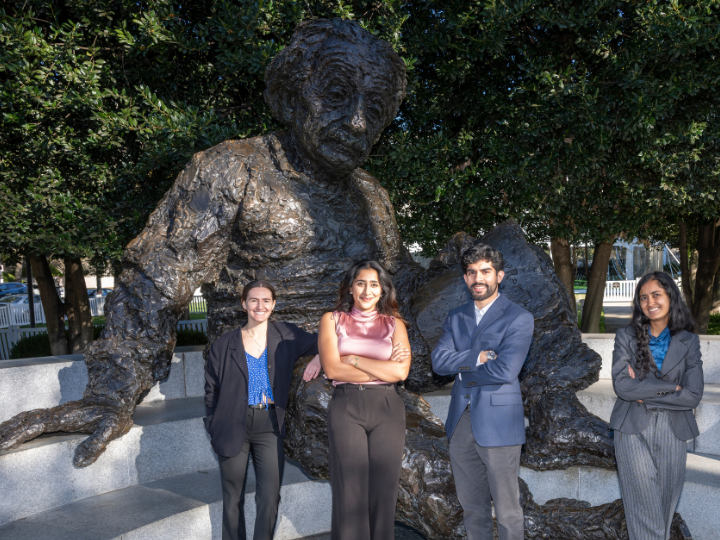
(From left) Talia Korobkin, Harnoor Sachar, Omar Anwar, and Shivali Vora, winners of the Interprofessional Prize.
Hosted annually by the National Academy of Medicine, the competition invites one team from each DC-area university to propose solutions to pressing health issues. This year’s case focused on the environmental risk factors driving chronic disease in Washington, DC, where air pollution, limited green space, and aging infrastructure place some neighborhoods at far higher risk for respiratory illness and other chronic conditions compared to others in the city. Teams were asked to address these risks using a hypothetical $1.5 million budget over a three-year period.
Georgetown’s Breathe Easy Proposal
Georgetown’s team, composed of Omar Anwar (C’26), Talia Korobkin (M’28), Harnoor Sachar (SFS’26), and Shivali Vora (SFS’26), presented a project titled “Breathe Easy: Improving Air Quality, Respiratory Health, and Environmental Justice in Washington, DC.” The students were mentored by Leticia Bode, Ph.D., professor in the Communication, Culture and Technology program and inaugural research director of the Knight-Georgetown Institute, and Oliver Johnson, Ph.D., managing director of the Global Health Institute.
The proposal focused on improving air quality in Wards 7 and 8, neighborhoods disproportionately affected by pollution and respiratory illness.
“We wanted to design a solution that did not put the responsibility of fixing systemic environmental inequities on the very communities most affected by them,” said Anwar.
The team envisioned greener, healthier neighborhoods through investments in reforestation, trail maintenance, and land reclamation projects. They recommended supporting community programs such as Code Green and urged the city to strengthen tree protection policies by increasing fees for removing large, healthy trees in these neighborhoods.
Within schools and senior living facilities, the team suggested installing low-cost air sensors to measure pollutants such as particulate matter and carbon dioxide. After six months of data collection, they would add air filters capable of removing nearly all airborne particles. The collected data would then inform a text-alert system that would share real-time air quality updates with residents.
Over the three-year implementation period, the initiative is projected to reach 20 elementary schools and 10 senior living facilities in Wards 7 and 8.
Interdisciplinary Collaboration in Action
The DC Public Health Case Challenge encourages collaboration across a wide range of disciplines to reflect the complex realities of public health work. Each team includes up to six students from at least three different disciplines.
“It was inspiring to see people from different fields come together as part of a bigger team,” said Sachar. “It is a reminder that public health is not a one-person job—it takes a village.”
After the competition, the Georgetown team shared their work at the National Academy of Medicine’s annual meeting, where they presented their proposal during a poster session. Their project will also be published by the academy, an opportunity that serves as preparation for Emory University’s International Global Health Case Competition.
Join the Team
Applications to represent Georgetown in an interdisciplinary team of three to six students open at the start of each academic year. All undergraduate and graduate students from any school at Georgetown are welcome to apply.
In preparation for the case challenge, the Global Health Institute partners with the Berkley School of Nursing through INnovations in Solving Problems through Interdisciplinary Research and Education (INSPIRE), a virtual case challenge held once per semester.
Sign up for the monthly global health newsletter to stay updated.