


Q&A with Global Health Institute Managing Director Nalini Anand
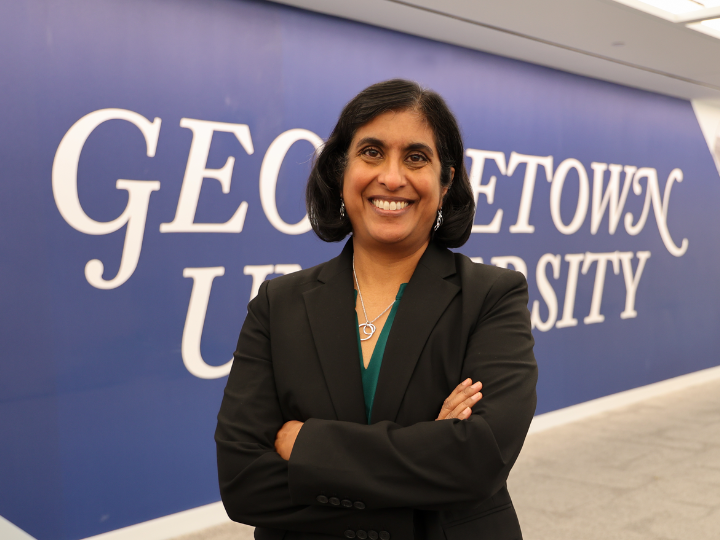
Nalini Anand, J.D., MPH, joins the Georgetown University Global Health Institute as managing director with decades of experience shaping global health policy and research, including senior leadership roles at the Fogarty International Center. In her new role, Anand will help guide the institute’s strategic planning and operations while working closely with faculty, staff, and partner centers, institutes, and initiatives across Georgetown University.
Your educational path is unique, studying Soviet studies at Cornell, then earning a J.D. at Stanford and later a Master of Public Health at John Hopkins. How have these different perspectives influenced your approach to global health?
I studied Soviet studies from 1988 to 1991, during the final years of the Soviet Union, as Mikhail Gorbachev introduced reforms that were dramatically reshaping the country. Our textbooks became outdated almost daily, and we had to continually adapt our learning to an evolving political and social landscape. That experience taught me how to reflect on political and societal change in an uncertain and fast-evolving environment, a reality that mirrors global health today.
My academic and practical legal training strengthened my ability to approach complex issues from multiple perspectives. Crafting arguments that account for different viewpoints is a valuable skill set in global health, particularly when engaging in advocacy and promoting greater equity in international partnerships.
I was motivated to pursue a Master of Public Health degree so I could contribute to global health dialogues in a more informed way. My coursework at John Hopkins emphasized cross-cutting topics that require a multidisciplinary lens, including law and public health, health in humanitarian crises, social determinants of health, and stigma reduction. This experience reinforced my commitment to catalyzing collaboration across disciplines to generate sustainable solutions to today’s complex public health challenges.
You led the creation of the Center for Global Health Studies at the Fogarty International Center at the National Institutes of Health. What were some key lessons from that experience?
Building and leading the Center for Global Health Studies was a privilege and the highlight of my career.
From the outset, it was clear that investing in people and creating a strong and cohesive team was central to the center’s success. Building the Center for Global Health Studies was a team undertaking from the beginning and fully dependent on team members feeling valued and empowered to grow and contribute to the larger mission.
Engaging partners early and with intention was equally important. Taking the time to understand their perspectives and incorporate their goals into decision-making required patience, but it ensured that our work remained relevant and impactful.
With limited resources, we also had to be strategic and forward-looking, focusing on critical gaps where we could add unique value and achieve concrete results.
What is one piece of advice you have received from a mentor that has stayed with you throughout your career?
One of the most influential lessons I learned came from a former boss, not through explicit advice but through her example. I watched as she consistently sought out information from a wide range of sources and created innovative ways to connect ideas and action. She never knew where the next idea might come from but was always actively listening and learning with a creative and open mind.
What did I learn? Stay insatiably curious, listen with big ears, and be ready to seize or create new opportunities.
What drew you to the Georgetown University Global Health Institute?
The Global Health Institute stood out to me as a catalytic force for global health at Georgetown, with a mission centered on collaboration and impact. I was particularly drawn to its role in convening partners across disciplines and translating research into action, as well as its commitment to supporting students through initiatives like the Global Health Student Fellows program.
More broadly, the institute’s mission reflects Georgetown’s longstanding focus on service, which strongly resonates with me. After nearly 25 years working in a mission-driven center at the National Institutes of Health, I value being part of a collective effort rooted in making a meaningful difference in people’s lives.
Now that you are nearly a month into the role, what early reflections do you have?
In such a few short weeks, I already feel like I am part of the Georgetown community. I am so grateful to have experienced such a warm welcome and sense of collegiality and collective purpose. Although these are challenging times for global health, I have felt a palpable determination to turn challenges into opportunities that Georgetown is uniquely poised to move forward. I am eager to harness this energy and help to further the Global Health Institute’s mission and global health across the university.
If you could have dinner with anyone, living or historical, who would they be and why?
It is tough to narrow this down to one person!
Harriet Tubman’s courage, strategic brilliance, and her compassionate commitment to others make her a profoundly inspiring figure for me. I would love to hear her reflections on how she overcame her fears, how she drew in others to help run the Underground Railroad, and what lessons we can learn from her experience as we continue to fight for social justice.
In reading Justice Sonia Sotomayor’s autobiography, I was struck by how her lived experience informs her approach to public service. I would be curious to hear how her life experiences have shaped her views of the law as a driver of social justice and what advice she would give to young people who aspire to address societal inequities.
Last year, I watched Jim Henson Idea Man, a documentary about the creative genius behind Sesame Street, the Muppets, and much more. I am in awe of how Henson’s vision has impacted early childhood development and imparted lessons of inclusion, humor, empathy, and kindness worldwide for over half a century. I would love to ask him how to best harness the creative arts to address today’s societal challenges and how he would instill hope in children who face enormous hardship and trauma.