


Global Health Institute Recognizes 2025-2026 Global Health Student Fellows in Year-End Showcase
This year’s cohort includes 21 fellows, chosen from a competitive applicant pool of more than 100 students, and represents five schools and 15 academic programs across Georgetown University. Since the program’s launch in 2017, the Global Health Student Fellows program, coordinated by the Georgetown University Global Health Institute, has engaged nearly 200 students of 30 nationalities.
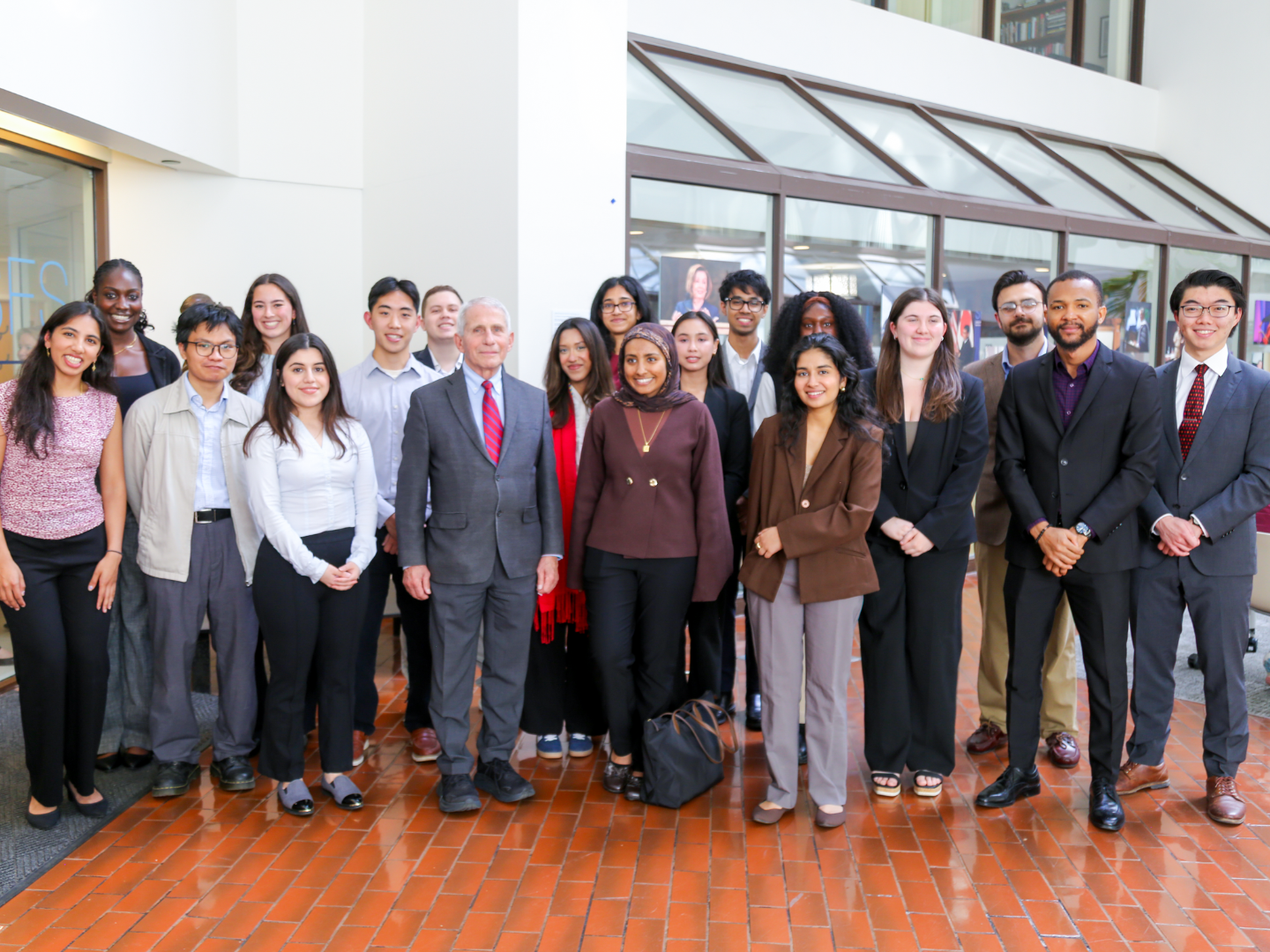
Over the course of the fellowship, the fellows worked closely with faculty mentors to design global health projects geared towards research, policy, or direct impact. They also engaged with senior faculty and global health leaders through monthly meetings, tackling pressing issues and reflecting on the shared values guiding their work.
Poster Presentation Highlights
A poster showcase culminated the fellows’ experience, challenging them to present their work in only two minutes. This was an exercise designed to show the importance of communicating key ideas clearly and effectively in fast-paced real-world scenarios.
In her remarks, Nalini Anand, J.D., MPH, managing director of the Global Health Institute, talked about the diversity of the fellows’ backgrounds and research focuses, which ranged from infectious diseases to health systems, artificial intelligence, and mental health.
“This year’s cohort [reflects] what makes Georgetown so unique and [is] a recognition that addressing today’s complex challenges demands collaboration across disciplines and often sectors,” she said.
A review committee composed of Sharon Kibwana, Ph.D., MPH, an assistant professor and program director at the Center for Global Health Practice and Impact; John Quattrochi, D.Sc., program director for the Master of Science in Global Health; and Steve Singer, Ph.D., director of the undergraduate major in biology of global health, recognized several fellows for their work.
Celebrating Standout Projects
Anees Baig (G’26), a graduate student in the Master of Science in Global Health program at the School of Health, received the award for Best Final Presentation for conducting a state-level analysis of primary health care in Nigeria, looking at 20,216 operational facilities across the country’s 36 states. Mentored by Ibrahim Bola Gobir, M.B.B.S., an assistant professor of medicine at Georgetown University Medical Center, Baig assessed service delivery capacity in maternal health, immunization, labor and delivery, and noncommunicable disease services.
“Receiving this recognition is incredibly meaningful because it reflects a year of learning, mentorship, and growth through work that connected global health research with real-world health systems challenges,” Baig said.
Fellow Research and Reflections
Runners-up included Leo Shih (H’26), an undergraduate student pursuing a degree in global health at the School of Health; Arnaz Reza (G’26), a graduate student in the Master of Science in Biotechnology at the School of Medicine; and Avery Simon (SFS’28), an undergraduate student pursuing a degree in science, technology, and international affairs at the School of Foreign Service.
Shih, who worked with Katherine Robsky, Ph.D., MPH, assistant professor in the School of Medicine, presented evaluations of the World Health Organization Harmonized Health Facility Assessment application in the Marshall Islands.
“The fellowship allowed me to get hands-on with data visualization and develop an understanding of the difficulties of collecting, managing, and interpreting real-world health data in the unique context of the Pacific Islands,” Shih said.
Reza, under the mentorship of Ellen Moscoe, D.Sc., director of experiential learning and assistant professor in the Department of Global Health, worked on a cost analysis of the Relief from Stress via Social Protection in Senegal (RESTORE) study, a community-based mental health intervention in Senegal.
“Mental health remains critically underfunded in low-resource settings, yet the need is immense,” Reza shared. “RESTORE showed that a community-delivered intervention like Self-Help Plus can be scaled in Senegal at a fraction of the pilot cost, making the case that effective mental health care doesn’t have to be out of reach.”
Simon, mentored by Emily Mendenhall, Ph.D., director of the Science, Technology, and International Affairs program at the School of Foreign Service, showcased work on science communication and accessible writing on global health through a study on the publication Science Politics.
“This work was important because it helped create pathways for people to better understand the connection between science and politics in a way that is accessible and understandable,” Simon said. “By making complex research and policy issues more engaging to the public, it aimed to contribute to a more informed, aware, and engaged future.”
Applications Opening for the Next Cohort
Applications for the 2026-2027 cohort open later this summer. Full-time Georgetown undergraduate and graduate students interested in global health are encouraged to apply. Faculty interested in partnering with the program can learn more by visiting the program website.